



Applications

Related Quantum Products
Discover how indie’s LXM-U Laser is revolutionizing quantum tech with ultra-low noise performance
Quantum
indie’s technologies are enabling the development of quantum applications that are poised to revolutionize many of today’s most cutting-edge technologies.
One of these areas of change is secure communication with Quantum Key Distribution (QKD), where single photons carry encryption keys across optical networks with quantum-level security. indie’s single-frequency 1550nm laser module LXM is the laser with the lowest noise available, making it the optimal source for quantum processes. In addition, indie provides high-precision filters to separate the most secure signals from noise, and dispersion compensation to embed quantum security into classical telecom infrastructure.
Our quantum offering also includes ultra-stable, narrow-linewidth visible DFB laser diodes, which provide a new capability for trapping, manipulating, and reading out quantum states with minimal disturbance. With the unique benefit of being tailorable to target specific atom or ion electronic transitions over the range 375 nm to 535 nm, this platform is ideal for creating quantum states supporting applications in quantum communications, atomic clocks, quantum sensors, and quantum computers. In particular for quantum computing, indie also offers custom design capabilities for realizing high-density arrays of emitters or of gain chips for realizing parallel computing or next-generation optical processing units.
indie’s quantum photonics portfolio offers a robust, scalable foundation for the next generation of quantum technologies that will provide safer communications, precision sensing, and quantum computing.

Biomedical & OCT
The ability to correct vision significantly improves many people’s quality of life. Modern refractive surgery methods in ophthalmology rely on lasers to modify the optical power of a patient’s eye. LASIK, lenticule extraction, and corneal ring segment procedures all utilize ultrashort laser pulses’ capability to ablate eye tissue without generating heat. However, lasers represent just one critical component of the surgical process. Precise measurement and positioning of laser ablation within the eye are of paramount importance. To achieve accurate visualization and system positioning, Optical Coherence Tomography (OCT) is employed as a diagnostic and guidance tool.
The field of urology also harnesses photonics in surgical procedures designed to minimize invasiveness and reduce recovery times. The 2-micron wavelength band is preferred due to its high absorption by water molecules, which are abundant in biological tissues. Lithotripsy and laser enucleation of the prostate are common procedures that leverage recent advances in fiber laser technology to increase treatment accessibility and effectiveness.

Coherent LiDAR
Frequency Modulated Continuous Wave (FMCW) LiDAR employs coherent detection to improve the Signal-to-Noise Ratio (SNR), ensuring accurate obstacle detection and real-time velocity measurements. These systems require high frequency-modulation rates to maximize data throughput, while optimal modulation linearity enhances range and distance resolution. Thanks to their high integrability, FMCW LiDAR architectures can significantly lower costs, paving the way for broader adoption in Advanced Driver Assistance Systems (ADAS).
Wind LiDAR leverages the Doppler shift of light reflected by particles to map wind speed and direction across various locations. This remote sensing technique relies on highly coherent laser sources to detect sub-picometer wavelength shifts. Often deployed in harsh outdoor environments, these systems require stable, reliable, and rugged lasers to deliver critical data.
indie’s LXM narrow-linewidth laser modules set the standard for reliability and stability in low-noise lasers. Their low frequency noise and precise frequency modulation response make them ideal for coherent lidar applications. The chip-scale semiconductor laser technology behind indie’s LXM modules is specifically designed for low-cost integration, making it an excellent choice for highly compact and integrated LiDAR architectures.
Scientific
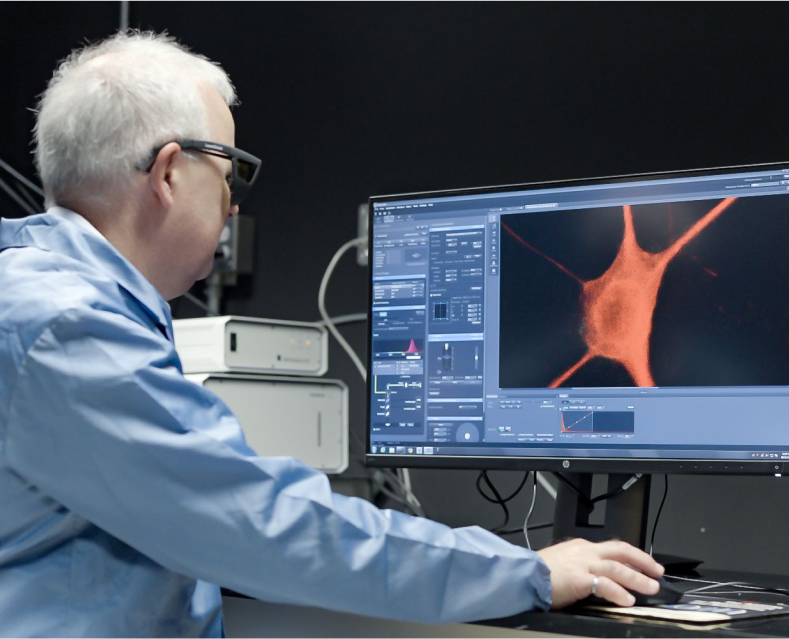
Microscopy has transformed biomedical imaging, enabling detailed observation of cellular and molecular processes. Fluorescence microscopy uses fluorescent markers to highlight cellular structures, while confocal microscopy employs laser scanning for sharper, 3D images. Light-sheet fluorescence microscopy (LSFM) enables rapid, low-damage imaging of live, 3D structures, making it ideal for developmental biology. Multiphoton microscopy excels at deep-tissue imaging with reduced scattering and phototoxicity. These advancements aid in understanding health, disease, and drug-cell interactions, driving diagnostic and therapeutic innovations.
THz radiation can penetrate non-conductive materials like plastics, fabrics, and biological tissues without ionization, making it ideal for detecting hidden threats and non-destructive testing. In spectroscopy, THz waves identify molecular signatures for chemical analysis, biological research, and pharmaceutical quality control. Its non-ionizing nature allows high-resolution tissue imaging, aiding medical diagnostics safely. Growing interest over two decades has driven the search for compact, efficient, and affordable THz sources to expand its applications further.

Fiber Sensing & DAS
Distributed Fiber Optic Sensing (DFOS) enables precise measurement of vibrations, temperature, and strain at any point along an optical fiber. Advanced systems can achieve sensing ranges of up to 100 km. Primarily used for critical security and industrial monitoring, DFOS applications include perimeter intrusion detection, border security, pipeline monitoring, cable monitoring and oil and gas extraction. Hundreds of thousands of kilometers of deployed fiber have the potential to serve as valuable sensors when monitored with a DFOS interrogator, enabling critical insights into applications such as highway traffic monitoring, smart city development, infrastructure maintenance for utilities, and seismic activity analysis.
indie’s ultra-narrow linewidth lasers and narrow-bandwidth filters deliver exceptional performance and stability, enhancing the sensitivity and range of DFOS interrogators. These products are specifically designed for field integration, offering best-in-class reliability and ruggedness for demanding applications.
Material Processing
With advancing technology, the sophistication of material processing must increase to enable new hardware to become manufacturable. Laser material processing was introduced several decades ago, and recent technological advances have sparked the need for more performant and accessible lasers.
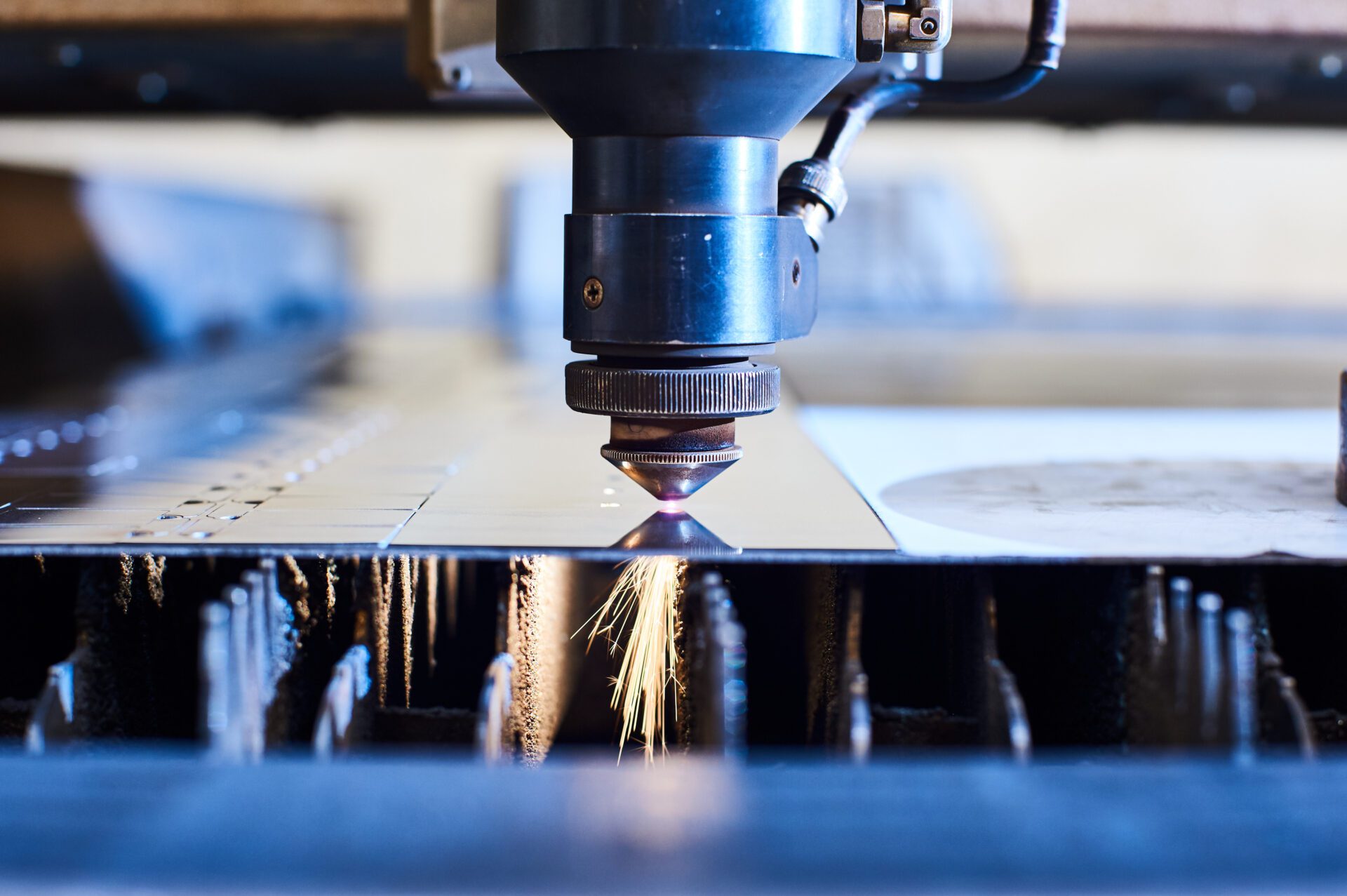
High-power fiber lasers are crucial for applications in metal cutting, welding, and additive manufacturing, focusing on precise energy control and the ability to process diverse materials with unprecedented speed and accuracy. Modern industries, including automotive manufacturing, now rely on high-power lasers to cut parts from metal sheets and produce complex components. Ultrafast lasers complement these technologies by revolutionizing material processing through extremely short pulse durations, enabling precise micromachining with minimal thermal damage. These lasers push the boundaries of advanced material processing by reducing mechanical stress and heat-affected zones in delicate materials like semiconductors and transparent substrates such as glass.

Aerospace & Defense
Navigation systems, such as those in avionics, aerospace, maritime, terrestrial, and subsurface applications, are of critical tactical importance for modern missions. Fiber-Optic Gyroscopes (FOGs) are an excellent solution for precise rotation measurements, particularly in defense and space environments that demand extreme temperature ranges, high shock/vibration resistance, and long operational lifetimes. When a FOG is integrated into a navigation system, it tracks orientation changes, enabling the system to accurately determine its position.
In recent years, the proliferation of low-cost equipment like first-person view drones has dramatically transformed the economics of traditionally expensive interception systems. Directed Energy (DE) laser systems now offer a very low cost per engagement, capable of deployment on ground, air, or sea platforms to neutralize targets with high-power laser technology. These sophisticated systems leverage either Spectral Beam Combining (SBC) or Coherent Beam Combining (CBC) techniques to achieve remarkable optical powers while maintaining sufficient beam quality.

Telecom & Datacom
Managing chromatic dispersion is a critical need in modern optical communication systems, particularly in telecom and datacom networks where high-speed data transmission over long distances is essential. Chromatic dispersion, caused by the varying speeds of light wavelengths in optical fibers, leads to signal distortion and limits system performance. Addressing this challenge ensures better data integrity and supports the increasing demand for higher bandwidth in applications like data centers and metropolitan networks. Effective dispersion management solutions reduce latency, optimize signal quality, and help network operators maintain reliable and efficient communication links.
In research and development, accurately emulating chromatic dispersion is vital for testing and validating optical communication systems. Engineers require tools to replicate the behavior of long-haul fiber links to optimize system designs and configurations. This emulation allows for the analysis of network equipment performance under realistic conditions without deploying physical infrastructure. With the rapid evolution of telecom and datacom technologies, dispersion management and emulation remain key to overcoming the challenges of scaling networks to meet ever-increasing data transmission requirements.